2–3 Year Window: U.S. Spouses Must Join a Loss of Consortium Claim
U.S. spouses: joinder, two–three year deadlines, comparative fault, and invasive discovery can kill a loss of consortium claim. Start a free CaseClosedFL...


A loss of consortium claim seeks compensation for a spouse or registered partner who has lost companionship, affection, or intimacy because an injury has damaged their marriage. It is a non-economic claim that rides on the injured person’s lawsuit and shares its deadlines. If your spouse was seriously hurt by someone else’s negligence, you may have a claim worth raising with an attorney now, before any settlement closes the door.
TL;DR:
- Eligibility for loss of consortium claims primarily depends on the applicant’s legal relationship status, with spouses most consistently recognized across states.
- The claim must typically be joined to the injured spouse’s case, risking complete loss if missed or filed after the statutory deadline.
- Consortium damages focus on intangible aspects like emotional connection and household support, without including medical bills or lost wages.
- Evidence supporting a consortium claim should include testimony, records, and witness accounts of relationship changes, as this proof is often challenged in discovery.
- State legal differences, procedural requirements, and potential defenses significantly influence whether a consortium claim can succeed or be barred entirely.
Table of Contents
- What Is a Loss of Consortium Claim, Exactly?
- Who Can Actually File a Loss of Consortium Claim?
- How and When Consortium Claims Get Filed
- What Consortium Damages Look Like in Practice
- What Proof and Discovery Actually Involve
- How State Law Changes the Outcome
- Common Defenses Against Loss of Consortium Claims
- Landmark Cases That Shaped Consortium Law
- Building Your Action Plan Before You Talk to a Lawyer
- Does a Consortium Claim Affect Divorce or Family Law Cases?
- An Editorial Take on the Human Side of These Claims
- Start a No-Obligation Eligibility Check With CaseClosedFL
- Sources
What Is a Loss of Consortium Claim, Exactly?
Consortium damages cover the intangible parts of a marriage that an injury can take away. Courts treat this as a distinct category from the injured person’s medical bills or lost income, and it belongs to the uninjured spouse individually, not to the injured party.
What typically counts:
- Loss of companionship and shared activities
- Loss of affection and emotional connection
- Loss of sexual relations
- Loss of household services the injured spouse used to provide
This is a non-economic claim, which means there is no invoice or receipt to hand a jury. You cannot bill for a missed anniversary trip the way you’d bill for a hospital stay. Medical expenses, lost wages, and the cost of hiring someone to do yard work or drive the kids to school are separate line items that belong to the injured spouse’s own claim, not yours.
Who Can Actually File a Loss of Consortium Claim?
Eligibility comes down to legal relationship status, and states are not uniform about it. Most jurisdictions limit standing to people with a recognized legal bond to the injured person.
- Married spouses are the most consistently recognized claimants nationwide.
- Registered domestic partners qualify in many states, though rules vary by jurisdiction.
- Unmarried romantic partners, no matter how long the relationship, are usually excluded.
- Filial consortium (a child’s loss of a parent’s companionship, or a parent’s loss of a child’s) is allowed in some states but not others.
Because eligibility and scope are governed separately by each state, you’ll typically need proof of your legal status, like a marriage certificate or domestic partnership registration, before an attorney will move forward. If you’re unmarried but living with a long-term partner who was seriously hurt, don’t assume you’re out of luck. Ask a lawyer licensed in your state directly, since the answer changes by zip code.
How and When Consortium Claims Get Filed
A consortium claim doesn’t stand on its own. It attaches to the injured spouse’s personal injury lawsuit and generally has to be raised at the same time.
- The claim is typically pleaded jointly with, or joined into, the injured spouse’s case rather than filed as a separate lawsuit later.
- If the injured spouse settles or goes to trial without the consortium claim included, the spouse may be barred from bringing it afterward.
- Comparative fault findings in the primary case, and the settlement or verdict amount there, directly affect what the consortium claim is worth.
- Statutes of limitations usually mirror the injured person’s deadline, often in the two to three year range depending on the state, though claims against government entities or medical malpractice cases can carry shorter notice windows.
Miss the joinder window and the consortium claim can disappear entirely, regardless of how strong the underlying facts are.
What Consortium Damages Look Like in Practice
There’s no price tag on a marriage, and that’s exactly the problem juries and courts wrestle with. Consortium damages typically cover loss of companionship, affection, intimacy, and the practical household support a spouse used to provide, from cooking dinner to managing the family’s finances.
What’s excluded matters just as much:
- Medical bills and future treatment costs (these belong to the injured spouse)
- Lost wages and reduced earning capacity (also the injured spouse’s claim)
- The injured spouse’s own pain and suffering (a separate category)
Statistic Callout: There is no fixed formula, percentage, or multiplier that converts a marriage’s disruption into a dollar figure. Awards are subjective, shaped by the severity and permanence of the injury, the couple’s life expectancy together, and how convincingly the loss gets documented. Two nearly identical injuries can produce very different consortium awards depending entirely on the evidence presented.
What Proof and Discovery Actually Involve
Winning a consortium claim means proving a negative: showing what the marriage used to be and how it changed. That requires evidence, and defense attorneys will test every piece of it.
- Testimony from both spouses describing the relationship before and after the injury
- Contemporaneous records like calendars, texts, or emails showing shared activities that stopped
- Photos and witness statements from friends or family who observed the change
- Household records showing who used to handle chores, childcare, or caregiving
Expect invasive questions. Discovery in consortium cases commonly probes the frequency of sexual relations, domestic contributions, and emotional support, through written interrogatories and depositions. It’s uncomfortable, and it’s standard practice.
Pro Tip: Start a simple journal now, dated entries noting what your spouse can no longer do together with you. A contemporaneous record carries far more weight with a jury than memory reconstructed two years later during a deposition.
How State Law Changes the Outcome
Consortium law is a patchwork, and where you live changes both your eligibility and your ceiling.
- California recognizes claims from spouses and registered domestic partners, with jury instructions that walk through specific factors like companionship and household services.
- Texas allows consortium claims but comparative fault findings against the injured spouse can reduce or bar recovery entirely, so the underlying case’s fault allocation matters enormously.
- Massachusetts treats consortium as a non-economic claim, but in medical malpractice cases specifically, statutory caps on non-economic damages can limit or restrict what’s recoverable, regardless of how compelling the evidence is.
- Minnesota enforces strict joinder rules. As one firm put it, a consortium claim there “is not the spouse’s own case, it is a passenger on someone else’s,” meaning failure to join it properly can extinguish it.
Four states, four different sets of guardrails. Never assume a rule from one state travels with you to another.
Common Defenses Against Loss of Consortium Claims
Defense attorneys rarely concede a consortium claim outright, and their strategies tend to fall into a few predictable categories.
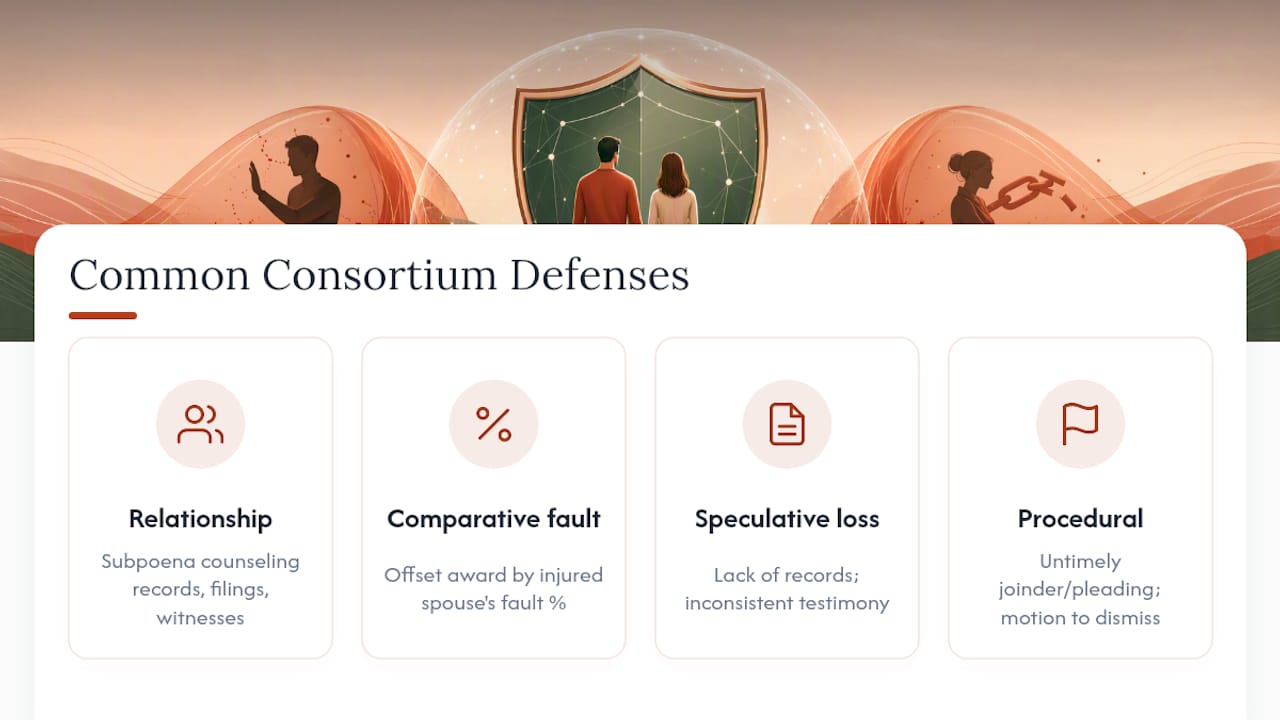
The most frequent defense challenges the relationship itself, arguing the marriage was already strained before the injury, or that the couple was separated, estranged, or headed toward divorce regardless of the accident. Defense counsel will often subpoena counseling records, prior filings, or witness testimony to build that narrative.
Comparative fault is another common angle. If the injured spouse bears some responsibility for the underlying accident, defendants argue that responsibility should reduce or eliminate the consortium award proportionally, particularly in states where fault percentages directly offset damages.
Defendants also frequently argue the claimed loss is speculative or exaggerated, pointing to a lack of documentation, inconsistent testimony, or a gap between what’s alleged and what the evidence actually shows. This is precisely why contemporaneous records and specific, concrete examples of lost companionship carry more weight than general statements of unhappiness.
Finally, procedural defenses matter. If the consortium claim wasn’t properly joined or pleaded within the statute of limitations, defendants will move to dismiss it on technical grounds before the merits are ever argued. Courts in states with strict joinder rules, Minnesota among them, take these procedural defenses seriously, and they can end a claim regardless of how sympathetic the facts are.
Landmark Cases That Shaped Consortium Law
Consortium law developed unevenly across the country, and a handful of cases still shape how courts approach these claims today.
Historically, consortium claims were recognized only for husbands seeking damages when a wife was injured, treating the wife’s services almost like property. Courts across most states eventually extended the same right to wives, recognizing that both spouses in a marriage suffer a comparable loss when the other is seriously hurt. That shift, playing out state by state through the mid-to-late 20th century, established the modern, gender-neutral framework most jurisdictions use now.
Later cases clarified the derivative nature of the claim, establishing that a consortium claim rises and falls with the underlying injury case. If the injured spouse’s claim fails or is barred, the consortium claim typically fails with it. Other rulings addressed whether registered domestic partners could bring claims equivalent to spouses, gradually expanding standing beyond traditional marriage in states that recognize domestic partnerships.
The joinder and timing issues highlighted in Minnesota case law remain some of the most cited cautionary examples nationally, precisely because they show how a substantively strong claim can be lost entirely on a procedural technicality.
Building Your Action Plan Before You Talk to a Lawyer
Waiting to sort through eligibility and evidence questions until the case is already moving costs you time you don’t have.
- Confirm your legal relationship status and gather documentation (marriage certificate or domestic partnership registration).
- Start documenting how your relationship has changed since the injury, dated and specific.
- Confirm the statute of limitations that applies in your state before it runs out.
- Ask any attorney you consult whether your state allows consortium claims and whether joining one could affect settlement leverage in the primary case.
- Coordinate directly with your spouse’s personal injury attorney rather than filing separately.
Bringing organized answers to these five points to your first consultation will save real time and help an attorney assess your case accurately from the start.
Does a Consortium Claim Affect Divorce or Family Law Cases?
A pending consortium claim can complicate a divorce, and the interaction runs in both directions. Because the claim exists specifically to compensate for damage to an intact marriage, filing for divorce while the claim is active raises an immediate question: is the marriage still the “consortium” being harmed?
Defense attorneys in the underlying injury case will seize on any divorce filing, separation, or marital counseling record to argue the relationship was already deteriorating for reasons unrelated to the injury. This is one of the most common defense strategies raised, and it can significantly reduce or eliminate a consortium award if the timing looks suspicious.
On the family law side, a consortium settlement or award is generally treated as separate, individual property belonging to the spouse who suffered the loss, not marital property subject to division, though this varies by state and depends on when the award was received relative to the divorce filing. Some states classify personal injury and consortium proceeds differently depending on whether they compensate for economic loss (which may be marital) versus purely personal, non-economic loss (which often is not).
If divorce is already a possibility while a consortium claim is pending, that is a conversation to have with both your personal injury attorney and a family law attorney simultaneously. Timing decisions made in one case can quietly undercut the other, and few people realize that until it’s too late to fix.
An Editorial Take on the Human Side of These Claims
Most people who reach out after a serious accident aren’t thinking about legal categories like “non-economic damages.” They’re thinking about a spouse who used to coach Little League and now can’t get off the couch without help. The gap between that lived reality and the paperwork required to prove it in court is where most families get discouraged, and honestly, where a lot of legitimate claims quietly die.

The uncomfortable truth is that consortium claims reward documentation over authenticity. A couple who kept a journal will often out-compensate a couple whose loss is arguably worse but poorly recorded. That’s not fair, but it’s how the system works, and pretending otherwise does readers a disservice.
CaseClosedFL’s intake process exists because most people don’t know where their state stands on joinder rules or filing deadlines until it’s nearly too late. Getting a case in front of the right attorney early, while evidence is fresh and deadlines are still open, matters more than almost anything else in this process.
— Luis
Start a No-Obligation Eligibility Check With CaseClosedFL
If you’re weighing whether to raise a loss of consortium claim alongside a spouse’s injury case, the clock matters more than the paperwork. A service exists that connects injured people and their families with attorneys who handle these cases regularly, without charging you anything to check whether your situation qualifies.
The intake process asks straightforward questions: what happened, who was hurt, whether fault has already been assigned, whether you have existing legal representation, and where you’re located. Caseclosedfl covers accident intake across several states, including Florida, California, Arizona, Texas, and New York, and every submission goes through human review before any attorney sees your contact information. Your details aren’t handed out to a list of firms hoping to solicit you. You can review exactly how that privacy protection works on the consumer disclosures page before you submit anything.
If your spouse was hurt in an accident and you’re wondering whether a consortium claim applies to your situation, start the eligibility check today. It takes a few minutes, costs nothing, and puts you in front of an attorney who can actually answer the state-specific questions this article can only outline.
Sources
- Law
- What Is Loss of Consortium In a Personal Injury Case? - Nolo
- Massachusetts Loss of Consortium Claims and Damages Explained – Catalyst Legal
- A Minnesota Consortium Claim Is Not the Spouse’s Own Case. It Is a Passenger on Someone Else’s. | Madgett Law, LLC
This article is general information, not a substitute for advice from a qualified lawyer. Consult a qualified legal professional about your own circumstances before acting on anything here.
Recommended
Frequently asked questions
Table of Contents What Is a Loss of Consortium Claim, Exactly? Who Can Actually File a Loss of Consortium Claim? How and When Consortium Claims Get Filed What Consortium Damages Look Like in Practice What Proof and Discovery Actually Involve How State Law Changes the Outcome Common Defenses Against Loss of Consortium Claims Landmark Cases That Shaped Consortium Law Building Your Action Plan Before You Talk to a Lawyer Does a Consortium Claim Affect Divorce or Family Law Cases? An Editorial Take on the Human Side of These Claims Start a No-Obligation Eligibility Check With CaseClosedFL Sources What Is a Loss of Consortium Claim, Exactly?
Consortium damages cover the intangible parts of a marriage that an injury can take away. Courts treat this as a distinct category from the injured person’s medical bills or lost income, and it belongs to the uninjured spouse individually, not to the injured party.
Who Can Actually File a Loss of Consortium Claim?
Eligibility comes down to legal relationship status, and states are not uniform about it. Most jurisdictions limit standing to people with a recognized legal bond to the injured person.
How and When Consortium Claims Get Filed A consortium claim doesn’t stand on its own. It attaches to the injured spouse’s personal injury lawsuit and generally has to be raised at the same time. The claim is typically pleaded jointly with, or joined into, the injured spouse’s case rather than filed as a separate lawsuit later. If the injured spouse settles or goes to trial without the consortium claim included, the spouse may be barred from bringing it afterward . Comparative fault findings in the primary case, and the settlement or verdict amount there, directly affect what the consortium claim is worth. Statutes of limitations usually mirror the injured person’s deadline, often in the two to three year range depending on the state, though claims against government entities or medical malpractice cases can carry shorter notice windows. Miss the joinder window and the consortium claim can disappear entirely, regardless of how strong the underlying facts are. What Consortium Damages Look Like in Practice There’s no price tag on a marriage, and that’s exactly the problem juries and courts wrestle with. Consortium damages typically cover loss of companionship, affection, intimacy, and the practical household support a spouse used to provide, from cooking dinner to managing the family’s finances. What’s excluded matters just as much: Medical bills and future treatment costs (these belong to the injured spouse) Lost wages and reduced earning capacity (also the injured spouse’s claim) The injured spouse’s own pain and suffering (a separate category) Statistic Callout: There is no fixed formula, percentage, or multiplier that converts a marriage’s disruption into a dollar figure. Awards are subjective, shaped by the severity and permanence of the injury, the couple’s life expectancy together, and how convincingly the loss gets documented. Two nearly identical injuries can produce very different consortium awards depending entirely on the evidence presented. What Proof and Discovery Actually Involve Winning a consortium claim means proving a negative: showing what the marriage used to be and how it changed. That requires evidence, and defense attorneys will test every piece of it. Testimony from both spouses describing the relationship before and after the injury Contemporaneous records like calendars, texts, or emails showing shared activities that stopped Photos and witness statements from friends or family who observed the change Household records showing who used to handle chores, childcare, or caregiving Expect invasive questions. Discovery in consortium cases commonly probes the frequency of sexual relations, domestic contributions, and emotional support , through written interrogatories and depositions. It’s uncomfortable, and it’s standard practice. Pro Tip: Start a simple journal now, dated entries noting what your spouse can no longer do together with you. A contemporaneous record carries far more weight with a jury than memory reconstructed two years later during a deposition. How State Law Changes the Outcome Consortium law is a patchwork, and where you live changes both your eligibility and your ceiling. California recognizes claims from spouses and registered domestic partners, with jury instructions that walk through specific factors like companionship and household services. Texas allows consortium claims but comparative fault findings against the injured spouse can reduce or bar recovery entirely, so the underlying case’s fault allocation matters enormously. Massachusetts treats consortium as a non-economic claim, but in medical malpractice cases specifically, statutory caps on non-economic damages can limit or restrict what’s recoverable , regardless of how compelling the evidence is. Minnesota enforces strict joinder rules. As one firm put it, a consortium claim there “is not the spouse’s own case, it is a passenger on someone else’s,” meaning failure to join it properly can extinguish it. Four states, four different sets of guardrails. Never assume a rule from one state travels with you to another. Common Defenses Against Loss of Consortium Claims Defense attorneys rarely concede a consortium claim outright, and their strategies tend to fall into a few predictable categories. The most frequent defense challenges the relationship itself, arguing the marriage was already strained before the injury, or that the couple was separated, estranged, or headed toward divorce regardless of the accident. Defense counsel will often subpoena counseling records, prior filings, or witness testimony to build that narrative. Comparative fault is another common angle. If the injured spouse bears some responsibility for the underlying accident, defendants argue that responsibility should reduce or eliminate the consortium award proportionally, particularly in states where fault percentages directly offset damages. Defendants also frequently argue the claimed loss is speculative or exaggerated, pointing to a lack of documentation, inconsistent testimony, or a gap between what’s alleged and what the evidence actually shows. This is precisely why contemporaneous records and specific, concrete examples of lost companionship carry more weight than general statements of unhappiness. Finally, procedural defenses matter. If the consortium claim wasn’t properly joined or pleaded within the statute of limitations, defendants will move to dismiss it on technical grounds before the merits are ever argued. Courts in states with strict joinder rules, Minnesota among them, take these procedural defenses seriously, and they can end a claim regardless of how sympathetic the facts are. Landmark Cases That Shaped Consortium Law Consortium law developed unevenly across the country, and a handful of cases still shape how courts approach these claims today. Historically, consortium claims were recognized only for husbands seeking damages when a wife was injured, treating the wife’s services almost like property. Courts across most states eventually extended the same right to wives, recognizing that both spouses in a marriage suffer a comparable loss when the other is seriously hurt. That shift, playing out state by state through the mid-to-late 20th century, established the modern, gender-neutral framework most jurisdictions use now. Later cases clarified the derivative nature of the claim, establishing that a consortium claim rises and falls with the underlying injury case. If the injured spouse’s claim fails or is barred, the consortium claim typically fails with it. Other rulings addressed whether registered domestic partners could bring claims equivalent to spouses, gradually expanding standing beyond traditional marriage in states that recognize domestic partnerships. The joinder and timing issues highlighted in Minnesota case law remain some of the most cited cautionary examples nationally, precisely because they show how a substantively strong claim can be lost entirely on a procedural technicality. Building Your Action Plan Before You Talk to a Lawyer Waiting to sort through eligibility and evidence questions until the case is already moving costs you time you don’t have. Confirm your legal relationship status and gather documentation (marriage certificate or domestic partnership registration). Start documenting how your relationship has changed since the injury, dated and specific. Confirm the statute of limitations that applies in your state before it runs out. Ask any attorney you consult whether your state allows consortium claims and whether joining one could affect settlement leverage in the primary case. Coordinate directly with your spouse’s personal injury attorney rather than filing separately. Bringing organized answers to these five points to your first consultation will save real time and help an attorney assess your case accurately from the start. Does a Consortium Claim Affect Divorce or Family Law Cases?
A pending consortium claim can complicate a divorce, and the interaction runs in both directions. Because the claim exists specifically to compensate for damage to an intact marriage, filing for divorce while the claim is active raises an immediate question: is the marriage still the “consortium” being harmed?
Ready to enter the accident details?
The eligibility form asks about the accident, injury, treatment, fault and representation before contact information.
Start Eligibility Check